That number - 224.35% - is the sound of a structural floor cracking.
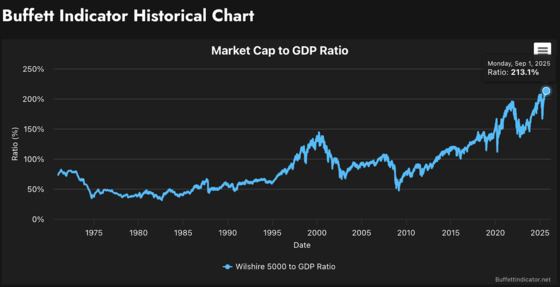
As of last month, the Buffett Indicator - the ratio of total market capitalization to GDP - hit its highest level in the 55-year history of the metric. We aren’t just "overvalued." We are in uncharted territory. To put this in perspective, the 55-year average is about 87%. We are currently trading at a 158% premium to that average.
While the mainstream talking heads on CNBC are still breathless about the "AI Revolution" and the next iteration of humanoid robotics, the smart money is looking at the plumbing. And the plumbing is backed up. When you see a reading that is 2.4 standard deviations above the historical trend line, you aren’t looking at a "bull market." You’re looking at a statistical anomaly that is mathematically unsustainable.
The mainstream is distracting you with shiny objects. They want you focused on the consumer-facing apps and the hype cycles. But if you look at the physical assets and the macro laws of gravity, the story is different. We are playing with fire, and the smoke is starting to fill the room.
Here is the thing about the "AI Boom": it has created a perfect storm of concentration risk. We’ve seen the Buffett Indicator surge 22% just since April of last year. That kind of vertical movement in a 10-month window doesn't happen in a healthy, "efficient" market. It happens when institutional capital flows become a stampede into a handful of "infrastructure" trades that have been bid up to insanity.
Let’s talk about the "Modified" Buffett Indicator for a second. Even if you want to be a "Fed-apologist" and account for the Federal Reserve’s total assets - essentially the "runaway printing" the mainstream loves to ignore - the ratio still sits at 184.6%. GuruFocus classifies this as "Significantly Overvalued."
But "overvalued" is a soft word. It’s a word for academics.
In the real world, where you and I operate, this translates to a projected -0.7% annualized return over the next eight years. Read that again. If you are holding the broad market today, the math suggests you will have less money in 2034 than you do right now, once you factor in the pathetic 1.06% dividend yield of the S&P 500.
The "Smart Money" knows this. They aren't waiting for a headline to tell them to exit. They are looking at the 13F filings that hit the tape yesterday, February 17th. They are looking for where the "Oracle" is hiding his chips.
I don’t care about the "brand" of Berkshire Hathaway. I care about the $330 billion in cash sitting on their balance sheet. That is the largest cash pile in the history of the company.
Why would the greatest investor of the last century sit on a third of a trillion dollars while the "AI Revolution" is supposedly minting millionaires?
Because he’s seen this movie before. In 2001, Buffett warned that when the ratio approaches 200%, "you are playing with fire." During the dot-com bubble, the indicator didn't even reach the levels we are seeing today. We have surpassed the 1999 peak. We have surpassed the 2008 peak.
The mainstream narrative is that "this time is different" because of the productivity gains from Physical AI and satellite networks. That’s horseshit. The macro laws of market cap vs. GDP are grounded in the physical reality of how much value an economy can actually produce. You can’t trade paper back and forth forever at 224% of GDP without a reset.
The February 17th 13F filing was the "smoking gun." While everyone else was buying the dip in overextended tech, the smart money was moving toward the exits - or more accurately, moving toward the "backdoors."

So, what is the "Smart Money Radar" actually tracking? It’s not the consumer brands. It’s the invisible infrastructure.

When paper assets become a liability, capital flows into things that have physical scarcity and essential utility. We’re talking about the "plumbing" of the future economy: the sensors, the actuators, and the hard assets that power the grid. But more importantly, we’re talking about the monetary reset.
History shows us a very specific pattern. Every time the Buffett Indicator hits these statistically extreme levels, it precedes a multi-year bear market and massive wealth destruction in equities. But that capital doesn't just "vanish." It migrates.
It migrates from "paper" to "hard."
This is why you see central banks and institutional giants frantically repositioning. They aren't buying the "hype"; they are buying the "hedge." The concentration in the tech sector has created a massive vulnerability. If the AI boom sees even a "healthy pullback," the broad market - tethered to that 224% ratio - will be dragged down with it.

On one side, you need a defensive anchor. When the Buffett Indicator is 2.4 standard deviations above the trend, you don't "hope" for the best. You protect what you have. This means moving away from overvalued paper and into the "infrastructure" of wealth preservation - specifically, the miners and hard asset suppliers that the mainstream ignores until it's too late.
On the other side, you look for the "Asymmetric" offensive play. This isn't about buying the most popular AI stock. It’s about finding the "backdoor" opportunities - the pre-IPO flows or the specific industrial automation suppliers that are still trading at reasonable valuations because they don't have a "cool" logo.
The 54-year cycle is turning. We are moving from an era of "cheap money and high multiples" to an era of "scarce assets and real value." If you’re still holding a portfolio built for 2021, you’re going to get crushed.
The Bottom Line
The U.S. stock market is statistically the most expensive it has ever been in 55 years. The Buffett Indicator at 224% is a flashing red siren that the "AI Hype" has detached from economic reality. With projected returns for the next eight years sitting in negative territory, the only logical move is to pivot.
Stop listening to the "everything is fine" crowd. They are the ones who will be left holding the bag when the 2.4 standard deviation move reverts to the mean.
Your Action Plan:
Audit your concentration: If you’re heavy in tech/AI, you’re sitting on a powder keg.
Follow the "Oracle": Buffett’s move to cash and hard assets isn't a fluke; it's a playbook.
Look for the "Backdoor": Focus on the small-cap miners and infrastructure suppliers that power the "physical" economy.
The 13F filings from February 17th have already started the clock. These opportunities - the ones that allow you to protect your wealth while positioning for 100X returns in the "hard" economy - won't last long once the mainstream finally wakes up to the 224% reality.
