Look at this single sheet of paper sitting on a mahogany boardroom table in Los Angeles.
There are no glossy graphics on it. No marketing buzzwords. It’s just stark, black text on a white background - a standard regulatory filing. But right there in the middle, buried in the alphanumeric soup, is a reserved four-letter code: $RADI.
This is what the starting gun looks like in the modern capital markets.
Here’s the thing: While everyone is watching Sam Altman and Google fight a public war over who can build the smartest consumer chatbot, the real story - the profitable story - is happening in the corporate plumbing. The mainstream financial media is completely distracting you with breathless hype about AI writing your emails or generating deepfake videos. That narrative is complete horseshit. The real money isn't in consumer toys; it's in the B2B infrastructure that powers the global economy.
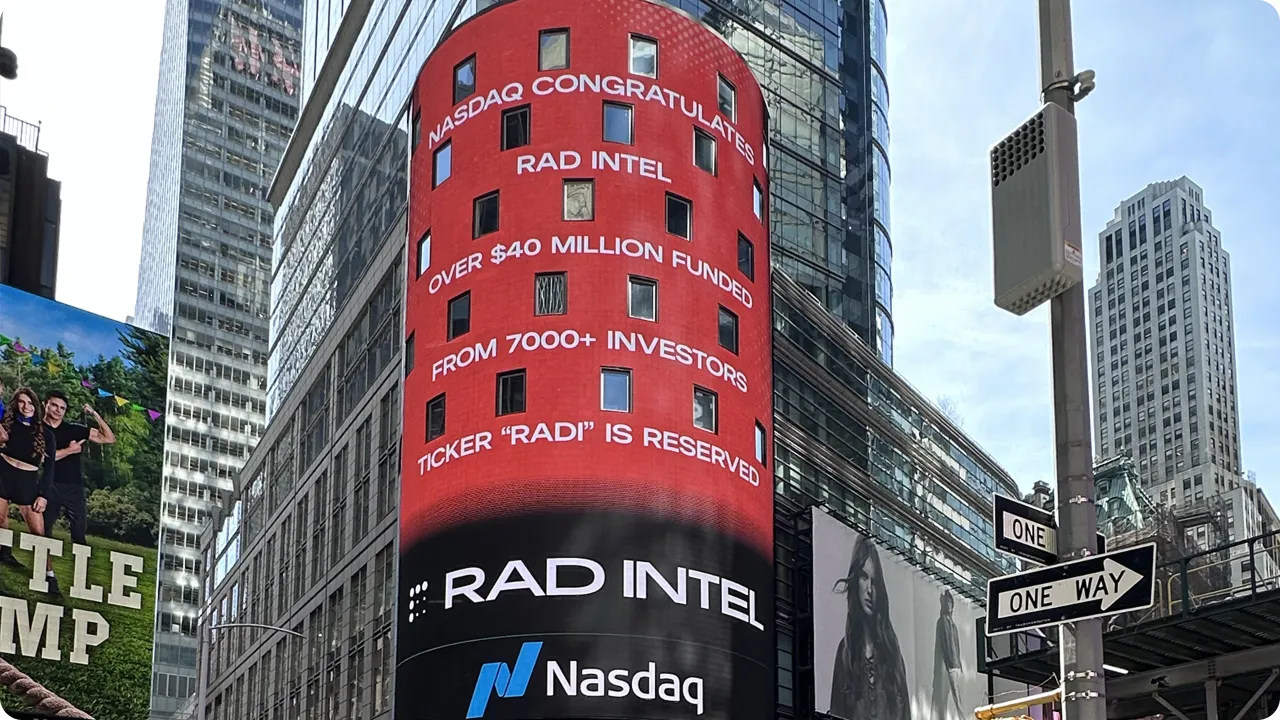
Right now, a company called RAD Intel is quietly building that exact plumbing. And the numbers coming out of their SEC filings and investor portals are staggering. According to their own site, they’ve just reserved the Nasdaq ticker $RADI as they advance toward a public listing.

Why does this matter? Because their valuation has surged a massive 5000% - exploding from a $4 million seed valuation to over $200 million in roughly four years.
This isn't a prediction. This is a documented, historical track record of capital formation. The smart money isn't waiting for the IPO bell to ring to buy into this growth. They are looking for the backdoors. And right now, an early-stage Reg A+ offering remains open at $0.85 a share. It’s a classic asymmetric setup: the mainstream is looking the wrong way, and the institutional-grade opportunity is sitting right here in the shadows.
The Reg A+ Anomaly: Front-Running Wall Street
If you want to understand how the wealthy actually compound capital, you have to look at the market structure.
For decades, the game was rigged. Private equity and venture capital firms would buy into a company at pennies on the dollar, wait for it to scale, and then dump their shares on retail investors during the IPO pop. By the time a ticker hit the Nasdaq, the explosive 5000% gains were already gone. You were just buying the exit liquidity for Sand Hill Road.

But the plumbing of the financial markets changed, and most people were too busy watching Jim Cramer to notice.
Enter the Reg A+ loophole. This is a specific SEC exemption that allows companies to raise capital directly from the public before they list on a major exchange. It’s the closest thing an everyday investor gets to a venture capital term sheet.
Let’s look at the hard data from Kingscrowd. On February 19, 2026, RAD Intel closed a prior round of its ongoing Reg A+ offering, raising $11.7 million at a $93 million valuation.
Read that again. The broader public will eventually see the $200M+ valuation when the company makes its larger moves, but the investors who utilized this Reg A+ backdoor were locking in at a $93 million valuation just weeks ago. In total, across multiple crowdfunding and D rounds, this company has pulled in over $60 million.
And they didn’t do it by begging a single mega-VC for a check. They did it by quietly accumulating a cap table of over 15,000 individual investors. This is a structural shift in how capital flows. The traditional gatekeepers are being bypassed, and the early-access window is wide open - if you know where to look.
Eliminating the "Creative Guesswork" Tax

Let’s cut through the Silicon Valley jargon. What does RAD Intel actually do?
If you look past the AI buzzwords, you find an infrastructure trade. Every year, Fortune 1000 companies waste billions of dollars on digital marketing that doesn't convert. It’s a massive, inefficient "creative guesswork" tax. Brands throw money at ad campaigns, cross their fingers, and hope the algorithm favors them. It sucks. It’s inefficient. And it’s exactly the kind of friction that AI was built to solve.
RAD Intel has built an AI platform that uses predictive intelligence to tell these massive brands exactly what will work before they spend the money. It generates measurable, documented ROI.
And we know it works because of the company they keep. According to their corporate site, they’ve raised this $60 million alongside serious institutional players and VCs like Expert Dojo and Adobe.
When a behemoth like Adobe - a company that literally built the software infrastructure for the creative world - is sitting on the same side of the table, you pay attention. This isn't a couple of kids in a garage trying to build a new photo filter. This is a hardened, B2B enterprise SaaS play. The valuation exploding by 5000% to over $200 million isn't a fluke; it's the market pricing in the fact that RAD Intel is becoming the invisible plumbing for a trillion-dollar marketing industry.
They are replacing human guesswork with algorithmic certainty. And in the corporate world, certainty is worth its weight in gold.
The Mechanics of the Nasdaq Path
Reserving a ticker symbol isn't just a cute PR stunt. It’s a legal and strategic milestone.
When a company files to reserve $RADI with the Nasdaq, they are signaling to the SEC, their auditors, and their institutional backers that the infrastructure for a public listing is being laid down. It means the audits are happening. The compliance frameworks are being built. The lawyers are billing hours.
This brings us back to the $0.85 per share reality.
Right now, the Reg A+ offering remains open at that exact price point. But as any seasoned investor knows, these windows don't stay open indefinitely. The moment that $RADI ticker goes live on a public exchange, the pricing mechanics shift entirely. You are no longer buying at a fixed, pre-IPO valuation. You are buying at whatever premium the open market dictates - and given the current appetite for pure-play AI infrastructure, that premium is usually brutal for retail buyers.
Look at the trajectory again: $4 million to over $200 million in four years. That kind of momentum creates a gravitational pull. As the company advances toward its public listing, the institutional capital that has to wait for liquidity will start circling.
By getting in at $0.85 through the Reg A+ backdoor, you are positioning yourself exactly where the smart money likes to be: already inside the house before the front doors are unlocked for the general public.

Pressure-Testing the Thesis: Why Crowdfunding?
Whenever I see a deal like this, I pressure-test the underlying logic. I ask the skeptical questions.
The most obvious one here: If RAD Intel is so damn good, why are they relying on crowdfunding? Why not just take a massive $100 million check from Sequoia or Andreessen Horowitz and be done with it?
If you understand the current market structure, the answer is obvious. The traditional VC model is broken. When you take a massive check from a single Sand Hill Road firm, you give up control. You get a board member who forces you to scale too fast, burn cash, and aim for a premature exit.
RAD Intel's reliance on crowdfunding - raising $11.7M at a $93M valuation in their recent Kingscrowd-tracked round, and $60M overall - is a deliberate, strategic weapon.
By bringing in 15,000+ individual investors, they haven't just raised capital; they’ve built an army of evangelists. Furthermore, they already have the validation of the Fortune 1000. When companies like Hasbro (NYSE: HAS) and Adobe (NASDAQ: ADBE) are adopting your AI platform, you don't need a venture capitalist to introduce you to clients. You already have the enterprise adoption.
This isn't a company struggling to find VC money; it’s a company that has actively chosen to bypass traditional VC scale to maintain control and reward the early believers. They are leveraging the Reg A+ structure exactly as it was intended - democratizing the early-stage gains that used to be locked up in private country clubs.
The Window is Closing on $RADI
Let’s connect the final dots.
We have a macroeconomic shift where AI is moving from consumer toys to critical B2B infrastructure. We have a company, RAD Intel, that has built the predictive intelligence to eliminate billions in creative guesswork for Fortune 1000 brands.
The numbers are completely transparent: a 5000% valuation explosion from $4 million to over $200 million. A proven ability to raise $60 million from over 15,000 investors, alongside heavyweights like Adobe. And a legally reserved Nasdaq ticker - $RADI - signaling the final approach to a public listing.
The mainstream media will eventually catch wind of this. They will write their breathless articles about the "new AI marketing giant" on the day it IPOs. By then, the $0.85 share price will be a historical footnote.
Don't be an idiot and wait for the CNBC segment. The private equity loopholes are open right now, but they are designed to close. The Reg A+ offering is live, but as the company states, the share price will change from $0.85 soon.
This is what an asymmetric opportunity looks like. It’s grounded in SEC filings, measurable ROI, and the invisible plumbing of the digital economy. The smart money is already moving. Act accordingly.
