While the mainstream media is busy breathlessy reporting on the latest celebrity AI chatbot or some "revolutionary" new consumer app that will be forgotten by next Tuesday, the smart money is looking at the plumbing. They’re looking at the invisible infrastructure that makes the entire $21 trillion U.S. economy actually function. Specifically, they’re looking at how the "Post-Cookie" world is being rebuilt from the ground up.
Here’s the split-screen reveal: On one side, you have the retail crowd chasing overhyped, overpriced tech stocks that have already peaked. On the other side, you have the "Sober Insiders" - the institutional players who understand that the real money isn't in the "front end" of AI. It’s in the back-end targeting, the ROI engines, and the proprietary data sets that allow a company like Sweetgreen to see a 188% boost in ad performance or Skechers to drive 89% higher engagement.
This isn't about "cool tech." It’s about the brutal reality of the bottom line. The old way of marketing - throwing money at a wall and hoping it sticks - is dead. We are entering the era of AI 2.0, where precise, intelligent targeting is the only way to survive. RAD Intel has spent 14 years in R&D to own this specific piece of the infrastructure. While you were watching Netflix, they were building the pipes.

The $RADI Ticker: The Institutional Backdoor is Opening

Look, I hate hype. If a narrative sounds too good to be true, it’s usually because someone is trying to sell you a bag. But when you see a company move from a $5 million valuation to over $200 million in under four years, you stop looking at the "story" and start looking at the math.
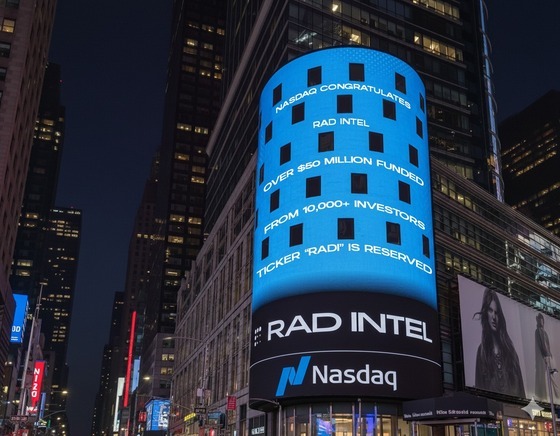
We are seeing a 127% CAGR (Compound Annual Growth Rate) heading into 2026. That isn't a "startup" number; that’s an infrastructure-scaling number. RAD Intel has already reserved its Nasdaq ticker symbol, $RADI. For those of us who track market structures, that is a massive "tell." It signals that the transition from private equity to the public markets is imminent.
In the world of asymmetric opportunities, you want to be in before the ticker hits the big board. Once Wall Street’s institutional machines start humming and the "buy" orders from pension funds start flowing, the window for the "Smart Money" entry is slammed shut. Right now, the entry point is $0.85 per share. Compare that to the public market pricing of the companies they are partnering with - like Omnicom (NYSE: OMC) or Hasbro (NASDAQ: HAS) - and you start to see the "backdoor" I’m talking about.
This is the "Barbell Strategy" in action: You hold your defensive assets - your gold, your physical wealth - and then you place your aggressive bets on the infrastructure that the giants are forced to use.
The Fortune 1000 Migration: Why the Giants are Moving

Here is the thing about the "Smart Money" Aspirant: You have to realize that companies like Hasbro and Omnicom don't move quickly. They are massive, slow-moving tankers. When they decide to pivot their entire AI marketing strategy to a partner like RAD Intel, it’s not a "test run." It’s a structural reliance.
Omnicom Media Group, which serves over 5,000 clients in 100 countries, isn't looking for "cool." They’re looking for ROI that they can report to their shareholders. When they choose RAD Intel for AI insights, they are effectively installing a new operating system for their global advertising spend.
This is why RAD Intel’s revenue has doubled heading into 2026. The revenue isn't coming from "hype" - it’s coming from recurring, seven-figure contracts with the world’s largest brands. This is what I call a "Physical Asset" play in a digital world. These contracts are the assets. The data sets are the assets. The proprietary AI that delivers a 3.3X ROI for MGM isn't just software; it’s a productivity multiplier that the market is only just beginning to price in.
The AIBO Strategy: The Ultimate Asymmetric Roll-up
If you want to know what the real "insiders" are doing, look at the M&A (Mergers and Acquisitions) strategy. RAD Intel isn't just growing organically; they are executing what they call the "AIBO" strategy - AI-Enhanced Buyouts.
They are acquiring agencies with $5M to $50M in revenue and $500k to $6M in EBITDA, then injecting their proprietary AI into those agencies to multiply the revenue. It’s a classic "plumbing" move. You take a boring, traditional business, install the high-tech pipes, and suddenly the throughput triples.
With a leadership team boasting $9 billion in M&A experience and over 14,000 investors already on board, this isn't a couple of kids in a garage. This is a professional-grade roll-up. They’ve raised over $60 million and are scaling for a world where "cookies" no longer exist. If you aren't positioned for the post-cookie marketing landscape, you’re basically trying to trade stocks using a 19th-century telegraph.
Protecting the Core, Targeting the Edge
Let’s talk macro for a second. We are in the middle of a massive monetary reset. Between S.1582 and the ongoing banking shifts, the "safe" money is looking for cover. This is why the Barbell Strategy is non-negotiable for the smart investor in 2026.
On one side of your barbell, you need the "Defensive Play." This is your physical gold, your wealth protection, and your hedges against a volatile dollar. You don't buy these to "get rich"; you buy them to stay rich.
On the other side, you need the "Offensive Play." This is where you target high-growth, asymmetric tech that is essential to the future economy’s infrastructure. RAD Intel fits this perfectly. At $0.85 per share, with a 4900% valuation surge already behind it and a Nasdaq ticker reserved, it’s the kind of "backdoor" opportunity that typically stays reserved for the VCs and the private equity sharks.
The mainstream will tell you to wait for the IPO. I’m telling you that by the time the IPO happens, the "asymmetric" part of the trade is gone. You’re just buying the leftovers. The real "Smart Money" move is to secure the infrastructure before the rest of the world realizes how vital it is.
Final Takeaway
Don’t be the person who looks back in 2030 and says, "I wish I’d seen the shift in the plumbing." The data is right in front of you. 14,000 investors have already seen it. The Fortune 1000 have already seen it.
The mainstream narrative is a distraction. The real story is in the pipes.
