"Boring" companies make the most money.
In 2021, while the rest of the world was chasing NFTs and meme stocks, the smartest money on Wall Street - Blackstone, Carlyle, and Hellman & Friedman - quietly wrote a check for $34 Billion.
They bought a company called Medline Industries.
You probably don’t know the ticker, because there wasn't one. It was private. You might not know the brand, because they don't sell to you; they sell to hospitals.
But Medline owned the infrastructure of the entire healthcare system. They manufactured the gowns, the surgical kits, and the supplies that kept the lights on. They were the "plumbing" of a trillion-dollar industry.
That deal was the largest leveraged buyout (LBO) in a decade. It proved one undeniable truth: If you own the infrastructure that Fortune 1000 companies rely on to survive, you essentially own a license to print money.
Today, we are looking at the next “Medline”. But this time, the infrastructure isn't medical supplies. It’s AI-Driven ROI.
A prominent tech leader recently stated that AI will reshape the workforce faster than most expect. It wasn’t speculation - it was a warning. But there’s another side to the story: AI is also creating entirely new economic opportunities for those who own the "pipes."
RAD Intel ($RADI) is at the center of that shift.
⚡ The "Medline Model": How to Spot a Private Giant Before the Exit
Let’s dissect the "Medline Trade" for a moment, because it is the perfect blueprint for what we are seeing in the AI sector today.
Medline didn't try to cure cancer. They didn't try to invent a flashy new drug. Instead, they focused on Efficiency. They built a vertically integrated supply chain that made it cheaper and faster for hospitals to operate.
They became an "Essential Utility." A hospital could fire its marketing team, but it couldn't fire Medline. If they did, the surgeries stopped.
The "Infrastructure" Moat
This is what we call an "Infrastructure Moat." When a company embeds itself into the operations of the Fortune 500, it becomes incredibly sticky. It generates recurring revenue that is recession-resistant.
For the last 20 years, the "Infrastructure Moat" was physical (warehouses, trucks, fiber cables). For the next 20 years, the "Infrastructure Moat" is Digital Intelligence.
The AI Mistake Everyone is Making
Right now, retail investors are making a classic mistake. They are chasing the "Consumer AI" hype - the chatbots, the image generators, the toys.
But the "Blackstones" of the world aren't looking at toys. They are looking for the Enterprise Infrastructure. They are asking: "Who is building the engine that allows Hasbro, MGM, and Skechers to actually make money with this tech?"
The answer is rapidly becoming a single company.
The "ROI" Crisis
Fortune 1000 companies are facing a crisis. They are spending billions on digital marketing, but their efficiency is plummeting. The old "cookie-based" tracking methods are dead (killed by Apple and Google privacy updates).
They are flying blind.
They need a new infrastructure - a new "Medline" - to deliver the supplies they need. In this case, the "supplies" are Predictive Customer Data.
They need a system that tells them: "If you spend $1 here, you will get $4 back."
This is the exact void that RAD Intel has filled. They have spent 14 years and millions in R&D building the plumbing that reconnects the broken wires of digital marketing.
And just like Medline, they have quietly integrated themselves into the biggest companies on earth while remaining private.
⚡ The "Pre-IPO" Window: Why $RADI at $0.85 is the Value Play of 2025

In First Part, we established that the real money is made in "Infrastructure," not hype. Now, let’s look at the specific asset: RAD Intel.
If you could have bought Medline stock before Blackstone wrote that $34B check, would you have done it? Of course. But you couldn't. It was a closed club.
The "Reg A+" Loophole
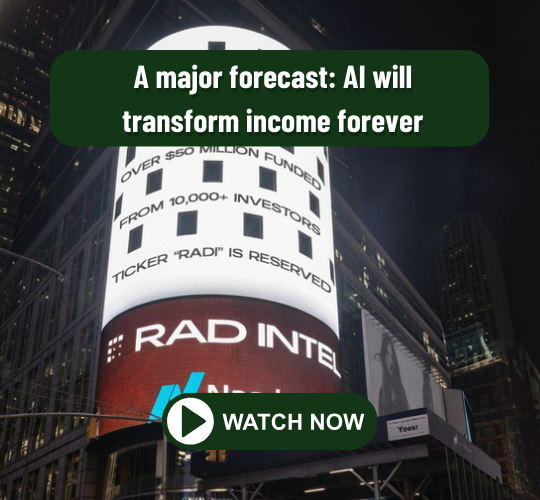
This is where the game has changed. RAD Intel is using a Regulation A+ offering to open their doors to retail investors before a potential public listing.
They have already reserved the ticker symbol $RADI on the Nasdaq. To a "Quant" investor, reserving a ticker is a "Declaration of Intent." Companies do not spend the legal fees to reserve a ticker unless they have a roadmap to liquidity.
The "Fortune 1000" Validation
We don't trust pitch decks. We trust contracts. RAD Intel isn't "hoping" to get clients. They are already embedded in the operations of the giants.
Hasbro
MGM
Skechers
L'Oreal (NYX)
These companies aren't using RAD Intel because it’s "cool." They are using it because the SEC filings show it delivers measurable ROI. RAD's system doesn't guess; it uses "Atomic Reach" AI (built on 14 years of R&D) to predict exactly which content will drive sales.
The Valuation Wedge
Here is the math: RAD Intel shares are currently priced at $0.85. They have grown their valuation by nearly 5,000% in 4 years (from a $5M seed valuation to over $200M today). They have doubled revenue year-over-year.
When a company with this kind of "Infrastructure" status goes public, the market typically applies a massive premium to it.
Current State: Private Valuation ($0.85). Illiquid. "Insider" Access.
Future State: Public Valuation ($RADI). Liquid. Institutional Markup.
The gap between those two numbers is what we call the "Liquidity Arbitrage."
The Conclusion
The AI transformation is inevitable. The workforce is reshaping. The marketing industry is being rebuilt from the ground up. You can watch it happen on CNBC in a year, or you can own the infrastructure today.
The window to enter at the $0.85/share valuation is open, but as we’ve seen with every "Pre-IPO" signal we track, these allocations fill rapidly once the institutional volume starts moving.
|
Sponsored Content
Something Interesting For You
|
We are interested in your opinion and concerns
Please share them in the Poll
⚡ We’re refining our research for the 2026 outlook. Where is your head at regarding the 'Private-to-Public' shift?
- The Cash-Flow Play: I’m looking for stable dividends and income-producing assets
- The Pre-IPO Growth: I want early-stage AI/Tech at private valuations before they hit the Nasdaq
- The Institutional Hedge: I only trust "Power Partners" and companies already working with Fortune 1000 brands
- The Sidelines: I’m currently 50%+ in cash/treasuries waiting for a correction
Your Feedback about yesterday’s Poll

12/16 - ⚡ Where are you hunting for the next massive 10x return?
